Across the Galaxy Archives
The Red Scarf
A prelude to ‘A Signal from Home’Jessa Marr signed the contract on a Tuesday because Tuesdays were when her mother sang in the choir. She wanted the call to go unanswered. The position was on Kepler Far, eight jumps beyond the core systems: four years' service, hazard pay, pension afterwards. With time displacement and relay paths, almost twelve years could pass on Earth. Jessa told herself numbers were easier to explain than farewell.
Her mother Ina called back before Jessa could close the contract. Choir had been cancelled. ‘Four years,’ Jessa said. Ina supplied the missing words: for you. Jessa would return with enough money to repair the house. Ina said the house did not need twelve years; it needed a roof.
They argued about damp in the cellar, Jessa's career, and the pear tree as though they were the same thing. At last Ina said, ‘At least take the red scarf. It's cold out there.’ Jessa laughed. Technology controlled the station temperature. Her mother packed it anyway.
Kepler Far studied gravitational waves near a dense star cluster where time ran fractionally differently. The work was demanding, the view impossible, the crew friendly enough. Jessa sent messages home each week. Ina answered from the kitchen with weather, neighbours, and news that the pear tree had suddenly borne fruit again.
The delay began at two months, then six. During Jessa's second year, conflict closed the Meridian Corridor to civilian data. Messages arrived in bundles or not at all. One day she received twelve recordings sent across nine months. In the first, Ina painted the kitchen yellow. In the last, she sat in a hospital and insisted it was only a check-up.
Jessa requested early return. The station council refused. Without her, the measurement programme could not continue; contracts allowed relief only for emergencies. ‘My mother is an emergency.’ The administrator answered, ‘Not for the station.’ Jessa hated him for the truth in it.
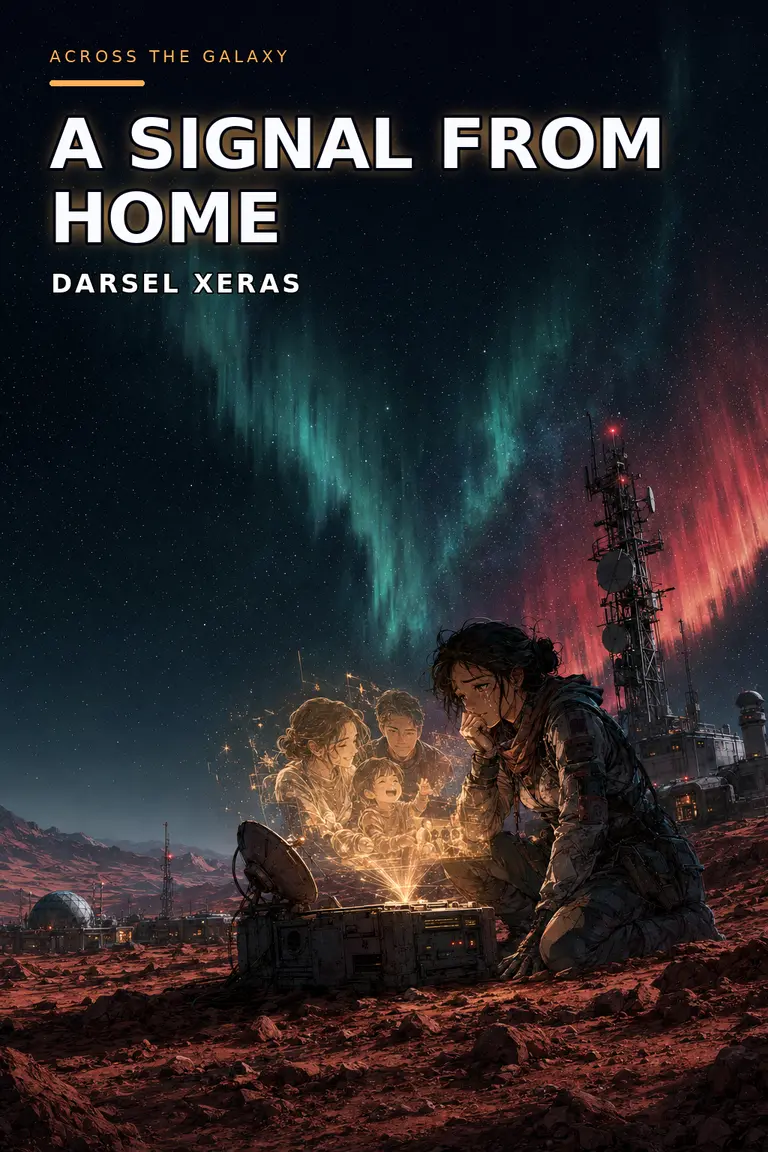
Ina recovered at first. In later messages she wore the red scarf Jessa had actually removed from her luggage on departure because it took too much room. Ina waved it at the camera. ‘See? One of us listens to me.’
In the third year, the Meridian relay failed completely. Kepler Far had supplies but no private link. Jessa kept writing messages and storing them: birthdays, apologies, descriptions of stars. She imagined playing them all one day in the kitchen. Ina would complain about the length and skip nothing.
When connection returned after eighteen months, there was no message from Ina. A neighbour reported that the house had been sold and Ina had died eleven months earlier—pneumonia, complications, very quickly. To the end, she had asked whether Jessa's contract would soon finish.
Jessa watched the message in control while people worked around her and gravitational waves crossed screens in coloured lines. A colleague touched her shoulder. Jessa returned to her cabin and found nothing that smelled of her mother.
She completed the four years, not from duty but because return had lost meaning. Then she renewed twice. Kepler Far became the place where nobody knew her earlier self. She rarely spoke of Earth. She did not delete her stored messages, but never played them.
Thirteen years and four months after departure, the station upgraded its systems. A technician found an old package with her family identifier in damaged relay memory. Its file name was INA_KITCHEN_44, dated weeks before Ina's death. Jessa ordered it deleted. The technician said only the end was damaged; most was readable. Jessa took the storage unit and left it in a drawer for seven months.
A new young technician, Sol, moved into the neighbouring cabin and cooked on Sundays for anyone willing to come. Jessa usually declined. One evening she smelled pears and spices from Sol's grandmother's recipe. The scent opened something she had sealed. She retrieved the file, sat at the screen, and still did not press play.
She remembered the last morning at home: Ina in the garden, red scarf over one arm, Jessa too busy with luggage to look at the pear tree. ‘When you return, it will be taller than the roof,’ Ina had said. Jessa promised a picture from space in which the house could be seen. Of course that was impossible.
After Ina's death, Jessa sold the house through an agent. The new owners sent a box of belongings. It had remained unopened in station storage. Inside were photographs, a recipe book, the brass tin of choir music, and at the bottom the red scarf. It smelled only of dust and cargo preservative.
Jessa wore it to the observation dome. Earth was invisible; its light had travelled years and could not be distinguished among billions of stars. Sol found her there and asked whether she wanted to know what Ina had said. Jessa knew: come home. ‘Maybe,’ Sol said. ‘Maybe she talked about the weather.’ Jessa laughed though it hurt. Ina had talked about every weather.
Back in her cabin, the file waited. A voice had taken thirteen years and four months to reach her. Jessa wrapped the red scarf around her shoulders, closed the door, breathed in, and touched the play symbol.
✦